#takeitback
What Can We As Citizens Do With 'End-of-life' Textiles?

Everything I’ve written about my #takeitback campaign, including how it began, all in one place. Here is the link to download your own #takeitback letter.
December 2024
The collapse of the so-called ‘rag market’ has been warned of for a while in the UK, but here is the reality.
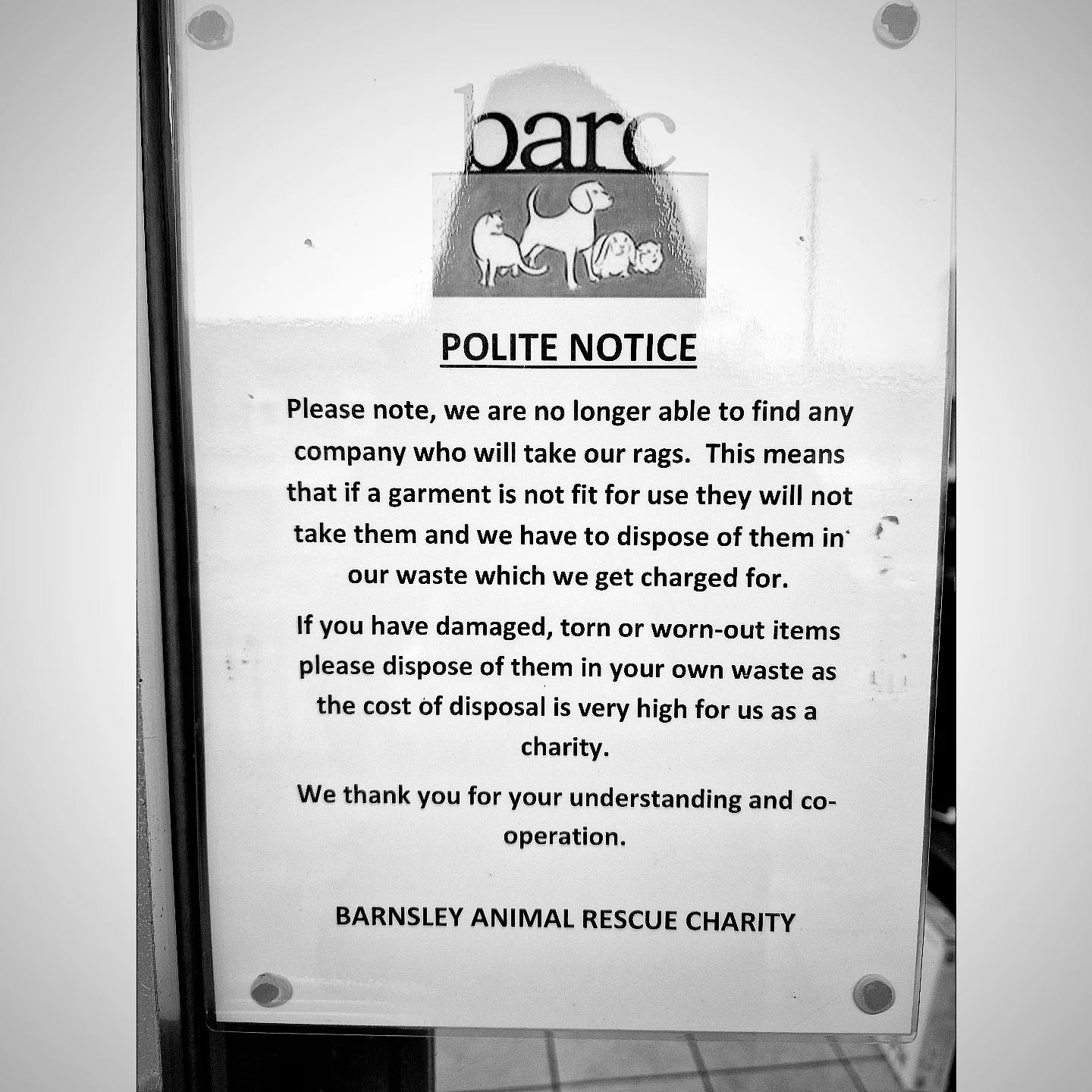
For anyone not familiar with how this works, most charities don’t have laundry facilities and are unlikely to repair damaged items. This means all charities (either in the back of the shop for smaller charities, or in centralised donation centres for some bigger charities) are forced to sort the clothing donations they receive, pulling out clean, undamaged items considered sellable for their shops.
Most of what’s left has traditionally been sold to what you might have seen called ‘textile recyclers’ but what are known within industry as ‘rag merchants’. They’re not dealing in ‘rags’ as we might imagine that word, but low quality, (in theory) perfectly usable clothes that we can’t be bothered to clean or repair, or are simply bored of, and remember, a large proportion of these clothes will be made from synthetic fibres (aka plastic). Rag merchants sell most of these items globally. This is the true ‘away’.
We’ve all seen the growing numbers of images of our used clothing piling up in the Global South and now these countries are beginning to stand up to waste colonialism (the correct term for these disposal methods) and along with low recycling rates in the UK of just 2%, the ‘rag market’ is collapsing.
SO WHAT CAN YOU DO?
1. Only give clean, undamaged good quality clothing to charities.
2. BUY FEWER CLOTHES so you have less of them to dispose of in the 1st place.
3. Write to your local council / MP to ask how they intend to deal with this growing problem.
4. Take responsibility for your own clothing waste.
5. Start returning garments to brands. We don’t yet have concrete plans in the UK for Extended Producer Responsibility (EPR), although it is being discussed.
February 2025
According to a report last year by WRAP (Textiles Market Situation Report 2024) over half of all post-consumer (pre-used) textiles in the UK (clothes, home textiles, shoes & bags) go directly to ‘end-of-life processing’ with 84% being incinerated for ‘energy recovery’. This is a growing industry since landfill taxes began to be increased significantly in the late noughties.
Energy recovery incinerators are predictably contentious, with claims of household recycling being incinerated instead of recycled and worries over the air pollution. In Sheffield we have one of these ‘energy recovery’ facilities, it powers a heat network in central Sheffield. A good solution you might think? However, a BBC report at the end of last yr (Burning Rubbish Now UK’s Dirtiest Form of Power, 15 October 2024), claimed that these incinerators are as damaging to air pollution as burning coal.
This was when I decided to return my first textile waste product back to its producer. It was a poly/cotton fitted sheet bought from Sainsbury’s over 10 years ago. Incidentally it was reported in June 2025 that the CEO of Sainsbury’s Simon Roberts had earnings in 24/25 of over £5million, shortly after the company announced 3000 job cuts in January 2025.
The full text of my letter is below:


I created a template for anyone to take action and return their own ‘end-of-life’ textiles to the brands that created them along with some guidance notes:
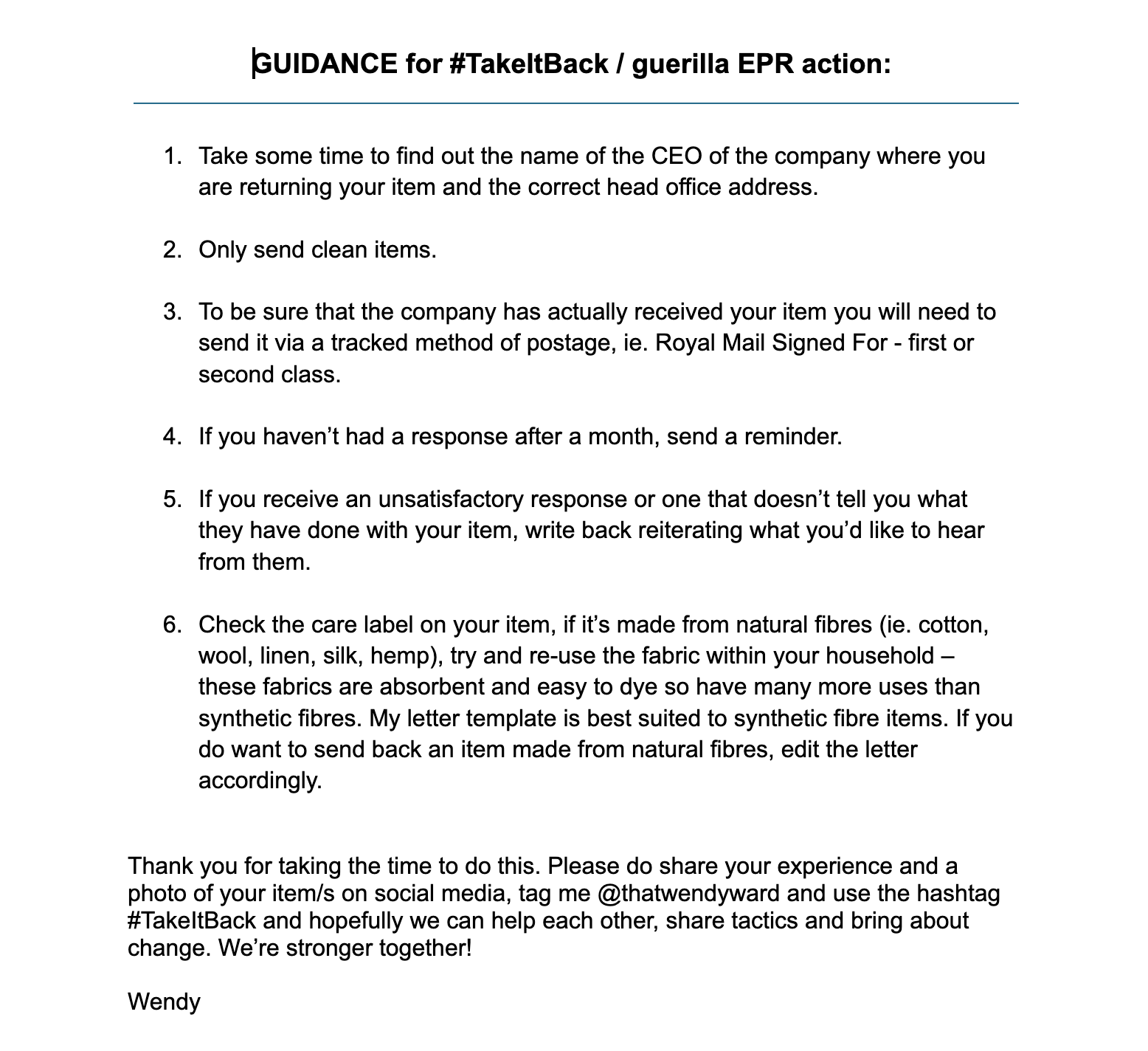
You can download both here.
February 2025
Less than two weeks later I had a reply from Sainsbury’s to my letter. Well, I say ‘reply’, it didn’t really say much, just a few cut and pasted stock phrases into an overall meaningless letter:
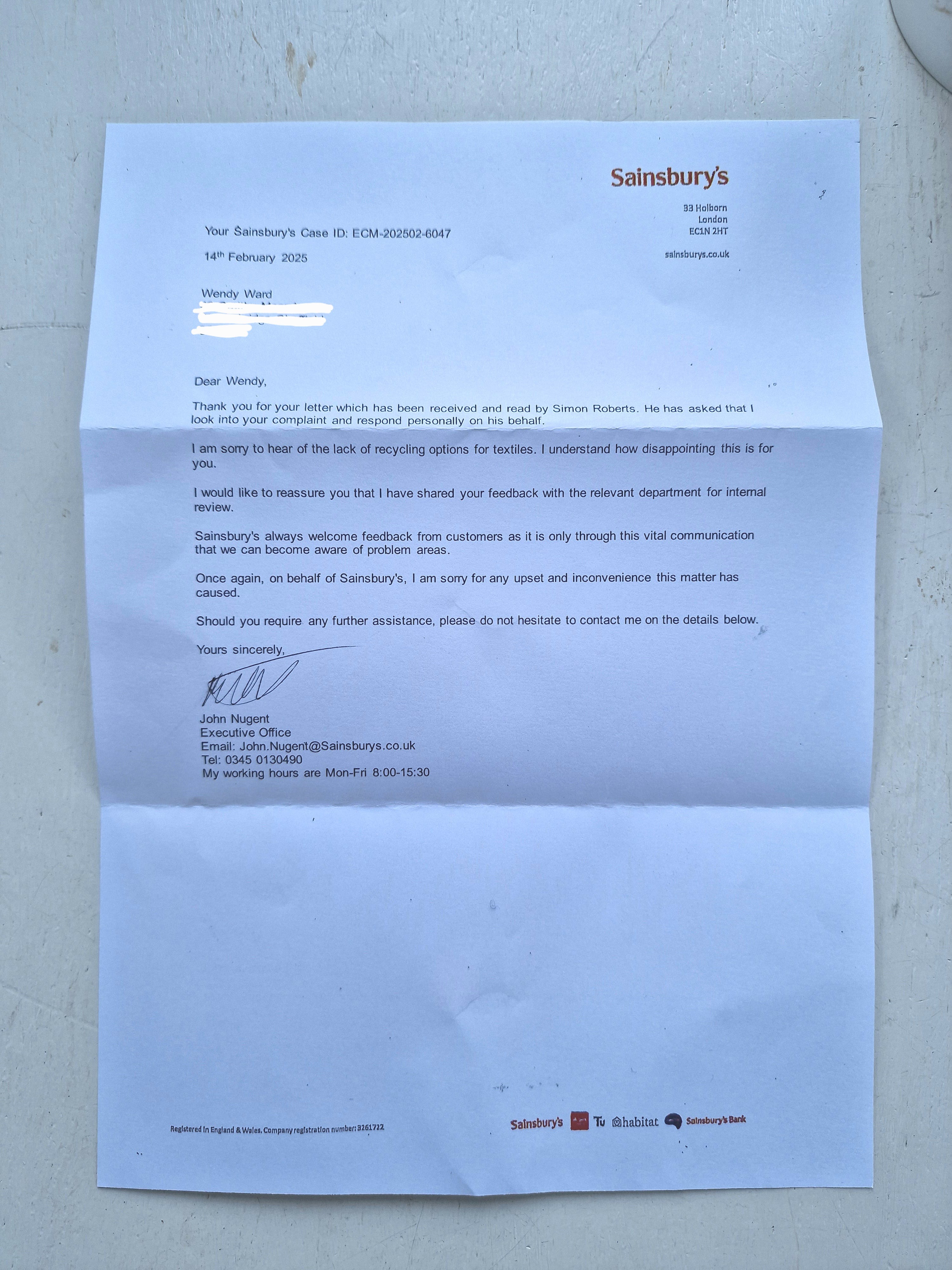
Impressive, huh?!
April 2025
Life took over, then a few months later I replied to the letter and had found another item to return to its maker: a pair of jeans belonging to my partner. Ironically they were also from Sainsbury’s and I chose to return them due to a large hole in one knee. Why didn’t you fix that Wendy, I hear you shout. I tried, but the denim had such a high elastane content, any fix looked a bit weird - like there was a pleat or something in the knee. Again, this was another fibre mix rendering the garment useless, almost impossible to repair to a satisfactory standard and with no known way for it to be recycled.
I used my letter template and put the jeans in the post.
This time it took a little longer for a reply.
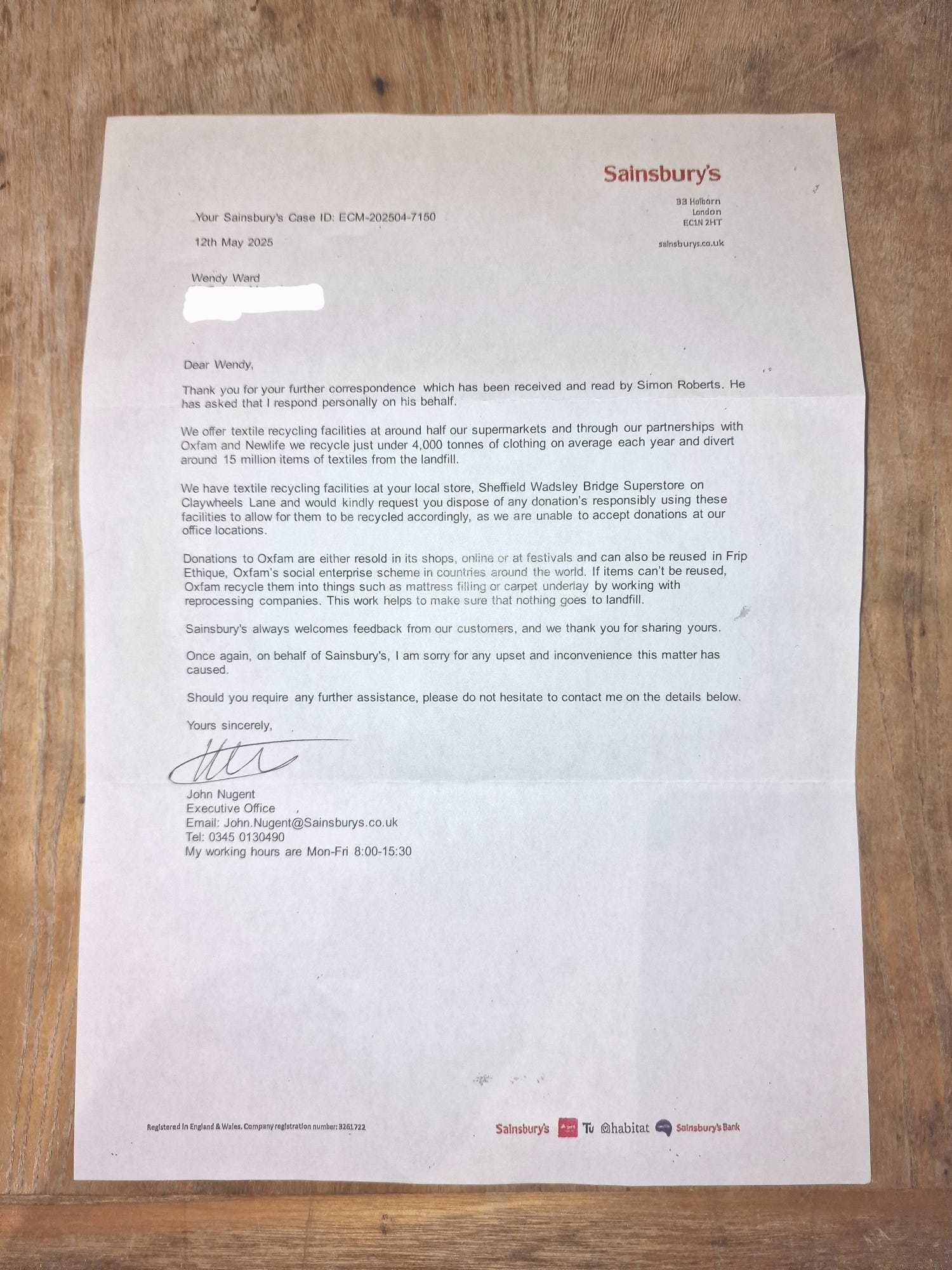
A little longer and from the same person, but no less non-committal and I think he’s missing the point, I wasn’t ‘donating’ the jeans and mistakenly sending them to Sainsbury’s head office, I want them to take some responsibility for them.
These two cases with Sainsbury’s are ongoing.
April 2025
Later than month came this, a surreal moment in my life appearing in the Guardian sitting atop 2 tonnes of textile waste!
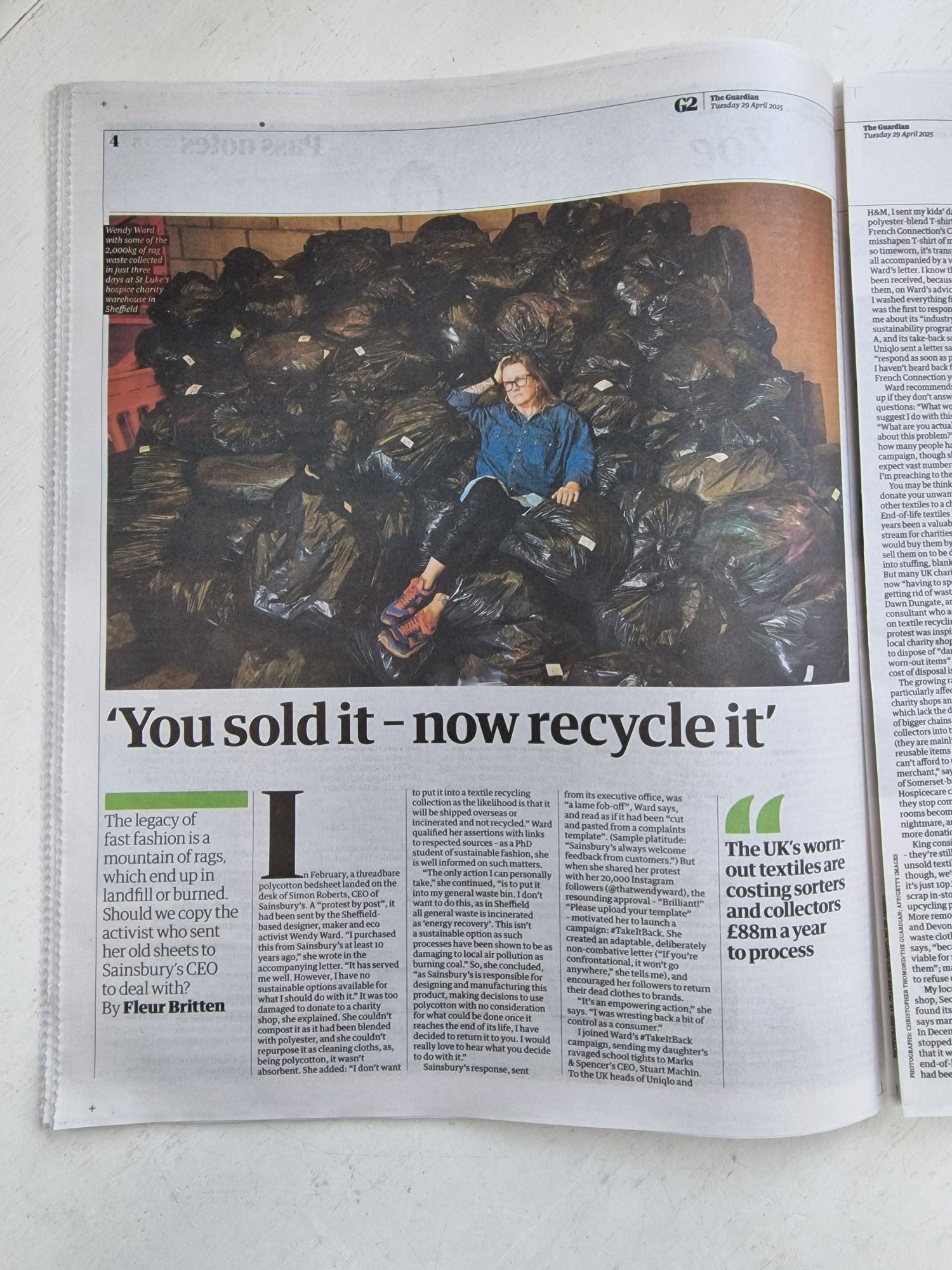
The brilliant article written by Fleur Britten about the current turbulence in the ‘rag’ market and my ongoing #takeitback campaign.
Something has to give in this overloaded system, it’s clear to me that we’ve been relying on charities to provide an infrastructure for dealing with our textile waste for free and that is coming to an end. There is established infrastructure for our paper, glass and metal recycling, why does government expect charities to do the same for our textiles?
I’d love to hear your thoughts on this subject and I ask you one question: will you #senditback?